
One For Papa
By Ring Lardner III

The sun was high and the desert was white, the kind of white that burns the memory out of a man’s head if he lets it.
Robert Lundahl sat in the dust of the Mojave, his back against the cooling metal of a machine that had seen better days, and watched the water disappear. It did not go all at once, with a bang or a great rushing sound. It went through a pipe — a long, cold, steel throat that took the lifeblood of the land and gave it to the city. He called it the Siphon.
He had been watching the siphoning for thirty years. He was a filmmaker, but he did not make the kind of films people watched to feel safe or to find a “Pretty Bullshit Picture” of the world. He made films like a man makes a clinical autopsy — with a sharp blade, a steady hand, and an eye that refused to blink even when the dust kicked up. He was looking for the marrow.
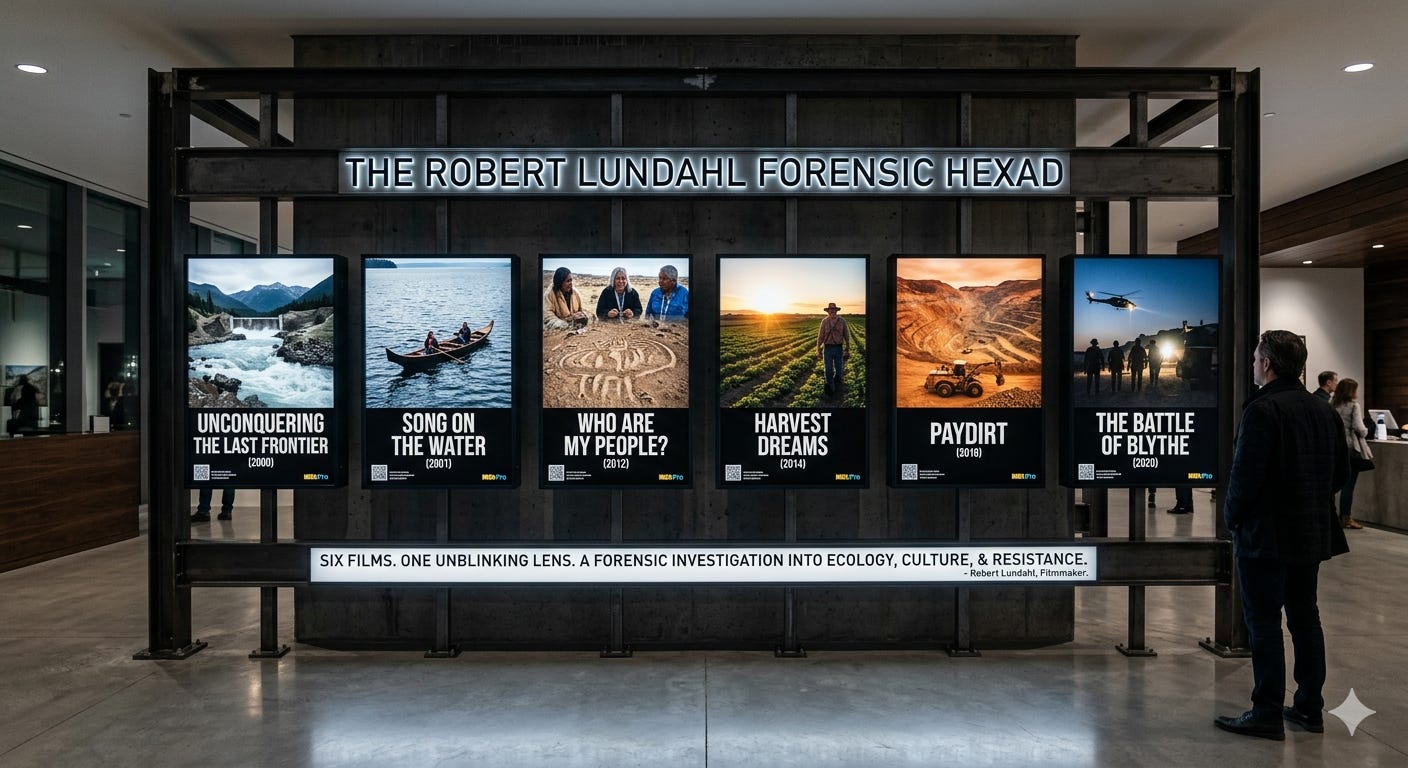
In the North, long ago, he had seen the Elwha die. The dams were built by men who spoke of progress with a fawning, intolerable obsequiousness, but they practiced a death march. They dammed the river and redacted the salmon, physically cutting the heart out of the Lower Elwha Klallam. Lundahl spent ten years in the mud and the rain to film that truth in Unconquering the Last Frontier. He saw that the “Last Frontier” was a simulation — a colonial lie told by the Design Orthodoxy to justify a century of theft. He watched the concrete fall, but he knew the ghosts of the fish were still there, waiting for the water to remember its way home.
Then he went to the sea, where the salt air bites the lungs. He watched the Coast Salish and the Nuu-chah-nulth pull their paddles through the dark liquid in Song on the Water. They were not performing a “cultural display” for a museum curator in Milan. They were reclaiming the Environmental Womb. They knew that kinship was a life requirement, and that the Western paradigm was a predator that had run out of soul.
The rhythm of the paddle was the only technology that mattered when the high-velocity “Simulation” of the state began to fracture.
In the desert, the jeopardy was closer and it tasted like alkali. He saw the Quechan erased by the state in Who Are My People? He saw men in suits, men with soft hands and hard hearts, take a man’s camera and his driver’s license. They kicked him down the road and told him he no longer existed. It was a violent erasure, a physical rape of the body and the land, done in the name of “energy” for a Stargate AI that needed more than the world could give. Lundahl filmed the beatings and the systemic assault because he knew that silence was just another word for the Siphon.
He followed the trail of the thieves to Hunters Point. He saw the U.S. Navy and their hirelings bury nuclear secrets in the soil and build houses on top of them. He called that PayDirt. It was a clinical indictment of liars and organized polluters who trucked radioactive soil to conventional landfills and called it “clean.” He saw the children playing on plutonium-soaked ground while the “Administrative” world performed another fawning shrug.
Then he saw the harvest fail. In the valley, where the sun is a hammer, he heard the song “Amazing Grace” as the protectors had heart attacks and the food cycle broke. That was Harvest Dreams. It was the sound of the Existential Void, the moment you realize the IPCC Accords are just procedural obstructions — pieces of paper used to hold down the Lid while the marrow is siphoned out.
The crowd in Milan did not know about the Siphon. They were in a room full of people fawning over a deconstructed Uzbek yurt at the Palazzo Citterio. It was a study in intolerable obsequiousness. They celebrated a nomadic ghost because it was an “objet d’art” they could curate and discard. They were somnambulists, dreaming of “green” solutions while their own paradigm was physically liquidating the West. They awarded “design” trophies to people who had never felt the hair stand up on the back of their necks in the presence of a ghost.
Lundahl stood in the center of the ring. He was the Envisioner, and he was alone with the bull. The bull was big and black and heavy with the weight of the $111 billion “Drey” merger and the shallow writing of the gatekeepers at Grist. It was the bull of ignorance, and it had been charging his CPU for thirty years.
The bull came fast. It came with the force of a high-velocity bullet. Lundahl did not move. He waited until the horn was a cold breath against his ribs, a terminal threat to his own existence. Then he stepped. It was a fast passage, a clinical sidestep born of the Bauhaus-driven refinement he had practiced since the Elwha.
The bull hit nothing but the aromatic breeze of human conscious progress. It stumbled, its industrial orthodoxy collapsing into the parched soil. It was a messy death for a clean-shaven lie.
Lundahl watched it fall. He had delivered the Six-Film Forensic Hexad — a terminal series of strikes that hit the bone. He had documented the fraud, the erasure, and the void.
The President of the Plaza — the Pulitzer committee and the investigative editors — stood to acknowledge the Actuality. They awarded him the trofeos. Two ears and a tail.
He did not stay for the applause. He walked out of the ring and back into the Mojave, where the ghosts of the wild animals were waiting. He was only here by the grace of the Actuality he hadn’t yet managed to redact. He had won the only fight worth the blood.
The Lid was off. The Sovereign Promise was made real again.
###